Enterprise hardware usually gets compared with competing hardware, which makes sense until the incumbent isn’t another piece of hardware at all.
Yesterday Snap announced new enterprise partnerships for SPECS. The target: retail floors, factories, and field operations.
SPECS cost $2,195, weigh 132 or 136 grams depending on size, and provide up to four hours of mixed-use battery life. Those numbers matter, but the product manager’s harder competitor is already in nearly every worker’s pocket.
The incumbent is a sequence of motions
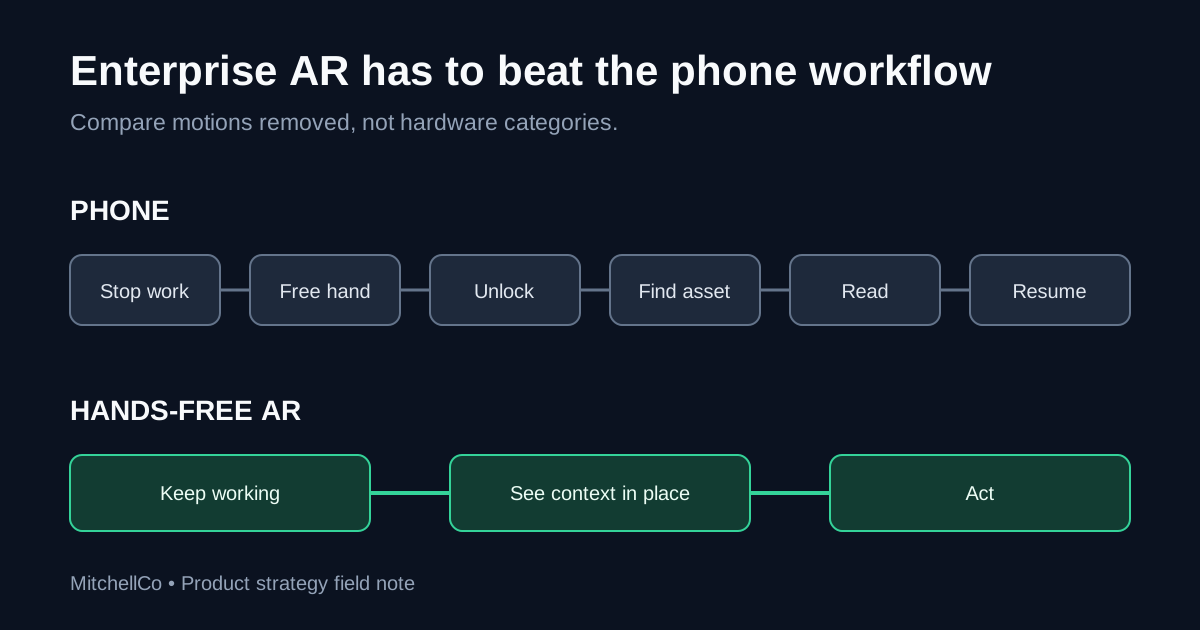
A technician using a phone doesn’t experience “mobile computing” as a category. They stop, free a hand, remove a glove perhaps, unlock the phone, find an app, search for the asset, wait for whatever authentication ritual IT requires, read something, put the phone away, then resume the actual work they were doing.
AR has to delete enough of that sequence to justify another device, another battery, another management surface, another training step, and another expensive thing somebody eventually leaves in a truck after a long Friday shift.
I’ve worked around hardware where a technically superior interface lost because the old workflow was annoyingly familiar. Familiarity has compounding interest, especially when the familiar tool already has a charger, an IT policy, and a pocket.
For enterprise SPECS, I’d measure the workflow at that level: interruption seconds per task, successful first-pass completion, hands-off-tool events, training time, and how often workers abandon the glasses for the old method. A pilot that reports only hours worn and user satisfaction misses the economic mechanism.
Battery life is a product boundary
Four hours of mixed use sounds respectable for standalone AR. It also means a product team can’t casually design an eight-hour shift around continuous wear.
Oddly, that constraint could produce a better product by forcing the team to choose where augmented reality actually earns battery time. Pick the parts of a shift where glanceable instructions, remote collaboration, inspection context, or spatial guidance remove measurable friction; don’t AR-ify lunch, walking to the break room, and every other minute merely because pixels are available.
Snap says it’s building management and security capabilities for enterprise deployment. That’s important because a useful pilot eventually acquires the less photogenic requirements: provisioning, identity, app distribution, device status, replacement, connectivity, and support.
At home, my kids have already perfected a simpler wearable-management protocol: if a device reaches zero percent, locate Dad. Enterprise IT will probably want something more formal.
The strongest enterprise AR roadmap may therefore look surprisingly selective, with fewer heroic all-day-use assumptions and more deliberately chosen moments. Find one repeated job where looking down is expensive, prove the glasses remove enough interruption to matter, then expand from that evidence.
A headset can win a spec comparison and still lose the deployment. Enterprise AR wins when a worker reaches for the phone, remembers they don’t need it, and keeps both hands on the job.
Related: Smart Modules Change the IoT Product Boundary.
Comments
Comments are powered by GitHub Discussions through Giscus.